
How to Get McLeod County Court Records
McLeod County court records are held locally by McLeod County District Court Administration, while many public cases can first be located through Minnesota Court Records Online. MCRO is useful for finding a case number, reading an available Register of Actions, and opening eligible public images. It is not the certified record. Court administration is the practical local custodian for inspection, a paper-file question, a certified product, or a document that is not visible remotely.
Choose the channel by the result needed. The courthouse terminal may show more statewide public material than remote MCRO. The counter can handle inspection and copy questions. A letter or the official request form can be mailed when travel is impractical. The statewide instructions also identify in-person, mail, and eFile and eServe routes for copy requests. The research did not identify a general public records email or a records drop box, so call before trying either.
- Find the case number in MCRO when possible. If it is unknown, note the county, case caption or matter description, and a useful date range.
- Name the precise item: a Register of Actions, order, judgment, filing, exhibit, or the accessible file. State whether inspection, a plain copy, a certified copy, or an exemplified copy is needed.
- Use MCRO for an eligible free image, a courthouse public terminal for a fuller electronic view, or court administration at the counter for a local request.
- For mail, send the identifying details, contact and delivery information, and payment as directed to court administration. Call first if considering fax because ordinary fax requests were not confirmed.
- Confirm the amount and delivery method before payment. An offsite file may take longer than a same-day request.
At the courthouse, the public terminal is the electronic fallback and the counter is the local paper-file and certification route. The court is at 830 11th Street E in Glencoe. It lists regular business hours of Monday through Friday, 8:00 a.m. to 4:30 p.m. The official materials do not identify a room number, floor-by-floor records map, or a guaranteed research service. Calling with a court file number before travel is especially useful for a paper or offsite record.
Note: A court copy request should avoid unnecessary protected information while giving the administrator enough detail to locate the correct McLeod file.
McLeod Court Record Access Levels
McLeod uses three distinct record-access levels. The first is a free statewide MCRO search and Register of Actions view. The second is the MCRO document viewer, which may offer eligible public images without charge. The third is courthouse and court-administration access, where a person can inspect local paper material, use a public terminal, request a plain copy, or obtain certification. Calling all three levels the same thing causes avoidable mistakes.
| Access path | Useful for | Important limit |
|---|---|---|
| MCRO case search | Case number, available Register of Actions, and public case details | It is an unofficial view and does not certify records. |
| MCRO document viewer | Eligible public document images | Availability depends on case type, date, and remote-access rules. |
| Courthouse terminal or counter | Inspection, fuller public access, paper records, and certified products | Older or offsite files can require added time. |
The channel that opens a result also tells the reader what it can prove. A free remote image is useful for reading an eligible public document. A terminal can extend the public search when remote access is narrower. Court administration can provide the formal copy product. This progression keeps a McLeod requester from treating a helpful online result as a complete record or treating a missing online item as a final denial.
The Minnesota Judicial Branch access page explains why courthouse terminals remain important even when a remote search exists. A terminal is not a promise that every restricted record becomes public, but it is the next channel when an eligible court record is not on the public web.
Types of McLeod County Court Records
One District Court administration supports the core McLeod record categories. That unified arrangement includes criminal, civil and conciliation, family, probate, juvenile, commitment, and traffic files. The category helps select the MCRO filter and the local phone route, but it does not decide whether every document or party detail can be viewed remotely. A city administrative notice can remain with the issuing city unless it becomes a District Court filing.
- Registers of Actions, which are chronological case-event histories.
- Filed pleadings, motions, notices, orders, and eligible document images.
- Judgments, satisfactions, and judgment-search results.
- Hearing information and the daily calendar as a settings source.
- Criminal, civil, family, probate, juvenile, commitment, and traffic case materials, subject to access rules.
The District Court’s unified model does not erase access differences. Public civil material may be available remotely in a way that a juvenile, domestic-abuse, commitment, or protected family item is not. A local records question should therefore identify both the case type and the item sought. That lets court administration distinguish an accessible docket entry from a restricted attachment, protected address, or sealed record before a request is submitted.
A Register of Actions can show that an event occurred, while the underlying order or judgment supplies the signed legal result. A case category also does not reveal an outcome. For a specific pending matter, the record itself and the court administrator are safer sources than a broad label in a search result.
McLeod Record Request Details
A short letter can be enough for an ordinary McLeod request. The statewide copy-request guidance says a form is not always required when the letter supplies the same usable information. Include the county, court file number if known, a case caption or descriptive matter name, the exact document or record, the desired certification level, contact details, delivery address, and payment information requested by the court.
Be specific without adding sensitive details that the court does not need. “Certified judgment in 43-CV-...” is more workable than a request for “everything.” If the case is older, not remotely visible, or kept offsite, court administration can explain the local search and retrieval path. The source does not promise a same-day result for an offsite file.
Requests for confidential or sealed material follow a different procedure. Do not send the same general letter and expect staff to disclose protected content. The access packet asks the court to decide whether access is appropriate. That decision comes before an ordinary copying request, even when a requester knows the case number or has seen a public case caption.
Practical choice: Use a case number when available, name the exact record, and say plainly whether a receiving office requires certification or exemplification.
What a McLeod County Court Record Contains
A public McLeod court record may contain a case number, court location, category, status, filing date, party-role labels, public attorney or judicial-officer fields, hearing information, Register-of-Actions events, available document links, and disposition data. The exact mix changes with the case type and the access rules. MCRO labels the event history a Register of Actions. It is a useful navigation record, not automatically the complete official file.
| Case Number | A local court identifier such as 43-CV for a civil routing clue or 43-CR for a criminal one. |
|---|---|
| Case details | Court location, category, active or inactive status, and filing date where public. |
| Register of Actions | Dated filings, hearings, orders, and other procedural events, not a guarantee of every paper in the file. |
| Documents | Names and viewer links for public images that are eligible for remote access. |
| Disposition | Judgment, satisfaction, sentencing, closure, or other public outcome information when the case and record allow it. |
Case prefixes are only routing clues. The local calendar has shown prefixes such as 43-CV, 43-CR, 43-FA, 43-PR, 43-JV, and 43-VB. They can help a requester distinguish civil, criminal, family, probate, juvenile, and traffic paths, but they do not describe every event or guarantee public availability. Court administration can verify an unfamiliar code or the proper record route.
A motion entry shows that a motion was filed. It does not show that the court granted it. Likewise, a calendar setting is not an outcome. When a signed order matters, request the order itself and ask court administration for a certified copy if the receiving party requires one.
McLeod Certification Is Local
MCRO may display a case or document without charge, but it cannot certify what it displays. McLeod County District Court Administration is the local source for a certified court copy, a certified judgment search, or an exemplified product. Certification is a court function, not a portal setting. A person seeking proof for another court or institution should ask that recipient whether a certified copy, an exemplified copy, or both are required before ordering.
The distinction matters because a judgment-search result is not itself a certified judgment. A plain remote image may be enough to review a filing. It is not a substitute when the purpose calls for the court’s official certification. The copy-request instructions identify in-person, mail, and eFile and eServe request channels for the certification route.
Minnesota eFile and eServe is the filing and service platform. It is not the public docket viewer. That distinction is useful for a McLeod requester who sees an e-filing reference on a court document and expects it to open a public case record. Use MCRO or the courthouse terminal for public case access, then use court administration for the copy or certification work that MCRO cannot perform.
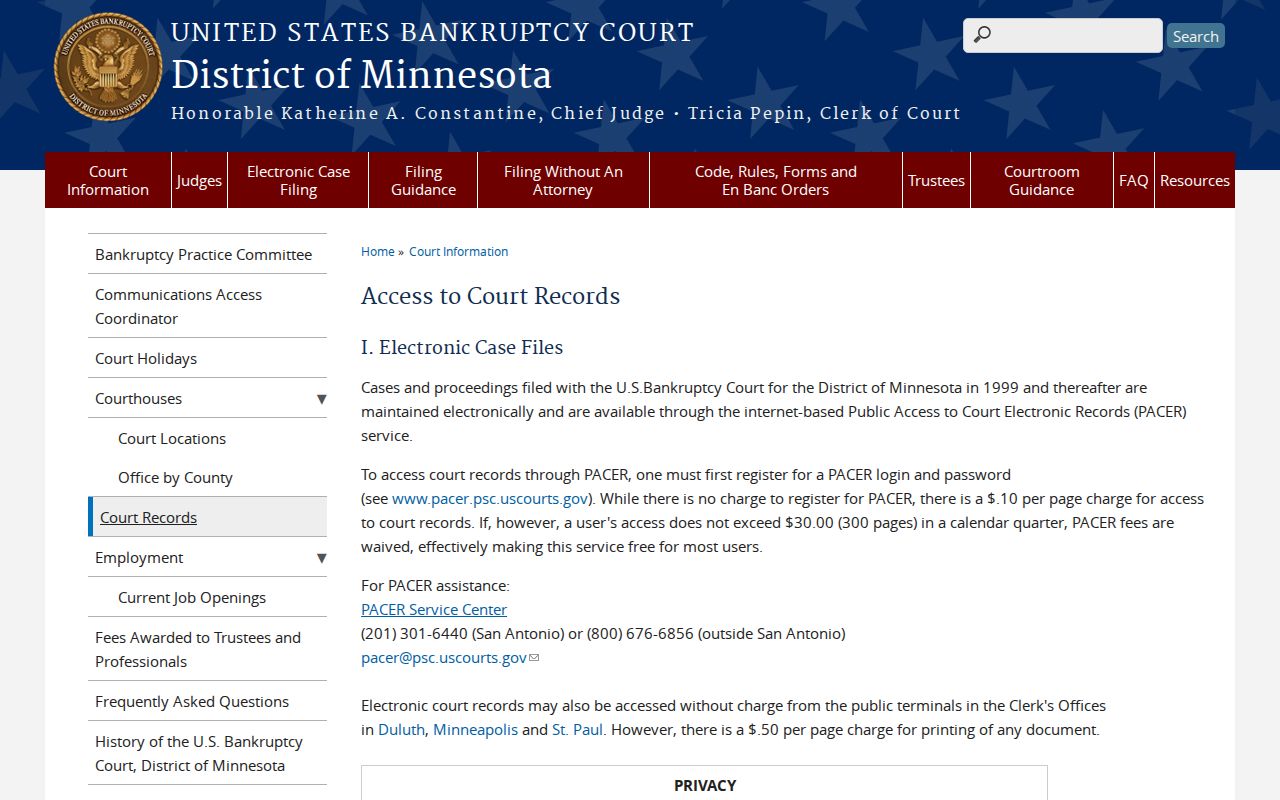
The District of Minnesota Bankruptcy Court access page illustrates why federal court records use a separate access system. A McLeod County address alone does not place a federal bankruptcy record in MCRO or at the local state court counter.
Certified Copies and Fees
The published Minnesota District Court fee schedule distinguishes free plain access from certified and exemplified work. The amounts below are record-access charges found in the research, not filing fees. McLeod’s county fee selector also shows a law-library addition on some filings, but that filing add-on is not a copy charge. Confirm the current total and payment instructions with court administration before mailing payment.
| Item | Amount |
|---|---|
| Plain imaged or e-filed document, scan, picture, or screen print | $0 |
| Certified copy or certified printout | $14 |
| Exemplified copy | $14 |
| Exemplified and certified copy | $28 |
| Certified judgment search for one name | $5 |
McLeod County District Court Administration
McLeod County Courthouse
830 11th Street E, Glencoe, MN 55336
(320) 864-1281
A case-management report is listed at $5 for 1 to 50 pages and $25 per 50 pages or part above that. Fax transmission is listed at $25 per 50 pages or part. Those published charges apply to the listed report or fax products, not to every contact with the court. A requester should describe the record first and let court administration identify the applicable product and amount.
The office is open Monday through Friday from 8:00 a.m. to 4:30 p.m. according to the court’s location page. Call before a special trip for an older file or a certification question, because the research does not promise that an offsite file will be available the same day.
McLeod Confidential Record Requests
A missing online document does not prove that a McLeod court record was deleted. It can be sealed, confidential, outside remote coverage, or protected by a case-specific order. A request for access to confidential or sealed material begins with the court’s CON100 and CON101 packet, not an ordinary copy letter. There is no identified filing fee for that access request.
The current form asks for the county, court file number when known, case type, the specific records requested, the requester’s interest and reason for access, and signed contact information. A judge decides whether and on what terms access is granted. Only after an access order should the requester use the regular copy path for the authorized material.
Juvenile access deserves special care. Minnesota law generally restricts juvenile hearings and records, subject to defined public exceptions and court control. A missing juvenile result should not be called expunged, dismissed, or deleted. The same caution applies to protected addresses, medical material, court-services records, and documents that are merely unavailable through remote public access.
The City of Silver Lake site is useful civic context, not a court-records database. A city payment or ordinance link does not confirm that a related McLeod District Court case was filed.
Public Access and Sealed Records
Minnesota begins with a presumption that court and judicial records are open for inspection and copying during regular hours, subject to the court rules and their exceptions. That does not make every item remotely available. Protected addresses and identifiers, juvenile and closed-proceeding material, medical and court-services records, sealed records, judicial work product, and other rule-defined classes can be unavailable or restricted. Remote access is narrower than the general courthouse-access presumption.
For McLeod County court records, the correct route depends on the exact item. Ask for inspection or a public copy when the material is public. Ask court administration whether redaction is possible when protected information is part of an otherwise public file. Use the court’s access-request packet when a sealed or confidential record needs judicial consideration. Minnesota judicial records are not governed by the ordinary executive-branch Data Practices Act timetable.
Key Rules:
Minnesota General Rules of Practice, Title VIII, Rule 2 - Court records are generally open for inspection and copying during regular hours, subject to the rules.
Title VIII, Rule 4 - It identifies categories that are not public, including protected and sealed material.
Title VIII, Rule 8 - Remote, bulk, inspection, and copying access follow a separate framework.
Minn. Stat. § 13.90 - Judicial-branch records are governed by Supreme Court rules rather than the general Data Practices Act process.
The access rule has a practical sequence. Start with the publicly available case information. If a record is public but does not appear remotely, try the courthouse terminal or request inspection through the local custodian. If a record is confidential or sealed, explain the particular material and the access basis through the judicial process. This keeps “public court record” from becoming an overbroad promise about a document image, juvenile file, or protected identifier.
McLeod court administration can help identify which route applies, but it cannot turn an unavailable remote document into an uncertified online copy. For a request that depends on a date, a filing, or a signed ruling, name that item. The more exact the requested court record is, the more accurately the administrator can explain availability, fee, redaction, and whether a court order is required.
McLeod Federal Record Searches
A case connected to McLeod County can still belong to a separate federal system. Federal civil and criminal matters use PACER and CM/ECF through the U.S. District Court for the District of Minnesota. Bankruptcy cases use a separate federal bankruptcy access route. Neither system is part of MCRO, and a federal case number will not use the local Minnesota 43- pattern.
The official District of Minnesota case-information page directs users to PACER and CM/ECF. CourtListener and RECAP can be supplemental federal research tools, but the court and PACER docket control for an official federal case. Keep federal fees and copy rules separate from the local state court fees listed above.
The distinction is especially important when a case number looks unfamiliar. The District of Minnesota example in the research uses a federal format such as 0:26-cv-03686-ECT-SGE, which is different from a Minnesota state court case with a 43- prefix. Federal cases also use separate clerk offices and copy charges. A local court administrator can help with a McLeod state court file, but is not the certifying source for a federal docket.
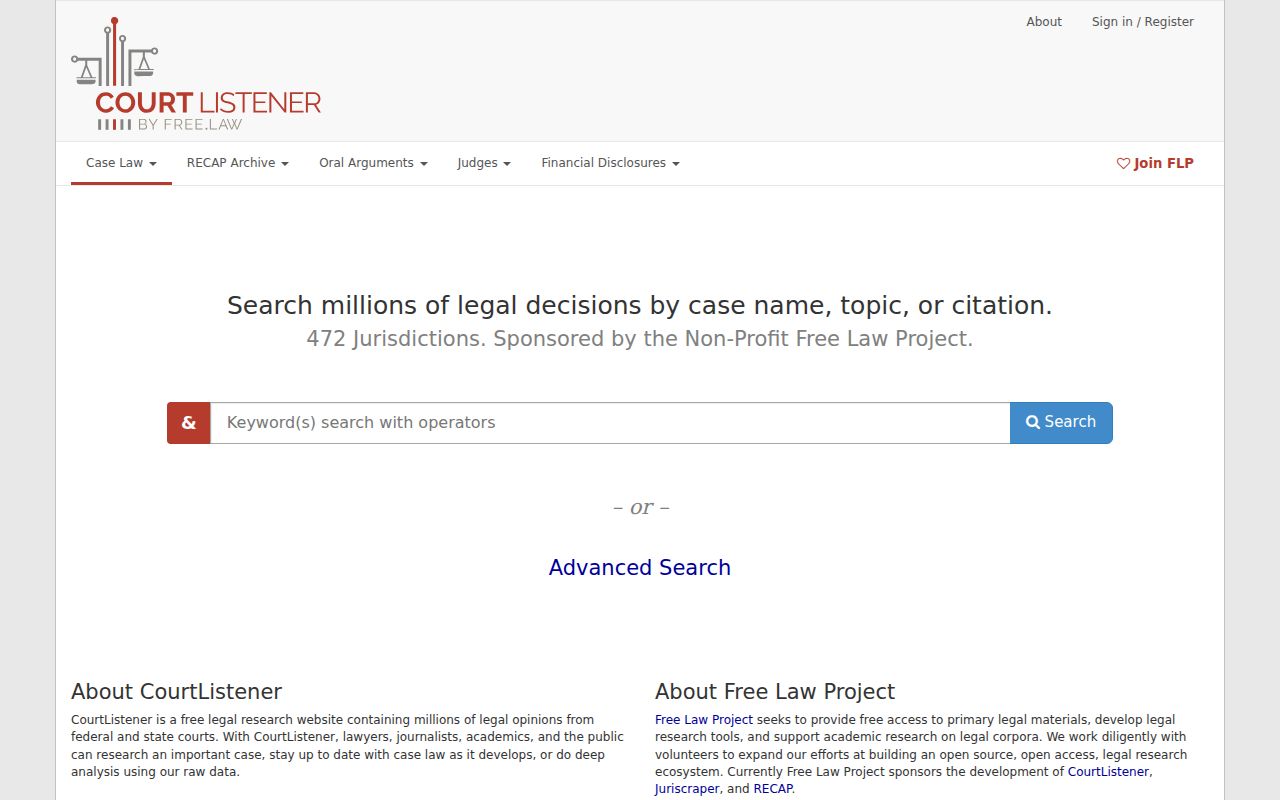
CourtListener can help locate publicly available federal docket material, but it does not replace the official federal court record or the McLeod County District Court record system.
Bankruptcy is a further separate federal channel. The Bankruptcy Court’s access material identifies PACER, CM/ECF, clerk access, and public terminals at its locations. That route can be relevant to a McLeod resident, but it is not an extension of MCRO. Use the case number and court name printed on the filing to keep the search in the correct system.
Note: A state court case and a federal case can concern the same people or events while remaining in separate court record systems.